Information in detail: Critically appraised.
Our books provide a detailed spotlight on three major battles that gave rise to our modern age. In so doing, we aim to critically appraise many of the myths surrounding them, often borne by national prejudice. The information and details about uniforms and equipment is just one very important way to be able to appreciate and re-evaluate the experience of the men and women who did not record their stories.
Junior Officer. Tver Dragoon Regiment. Russian Advance Guard at Austerlitz.
The Figure on the right is a Junior officer in the Tver regiment. His officer distinctions include his white crest with black front and his silver sash, flecked with black and orange thread. As an officer, he has no crossbelt or cartridge pouch or sword-frog like lower ranks, but carries his sword on slings like the Russian heavy cavalry. Although the standard dragoon pallash-sword was meant to have a brass hilt, the metal covering for the sword scabbard could be either brass or white-metal, depending on the button colour of the regiment. When not on campaign, officers carried an epee on a sword-belt and frog as part of their undress uniform.
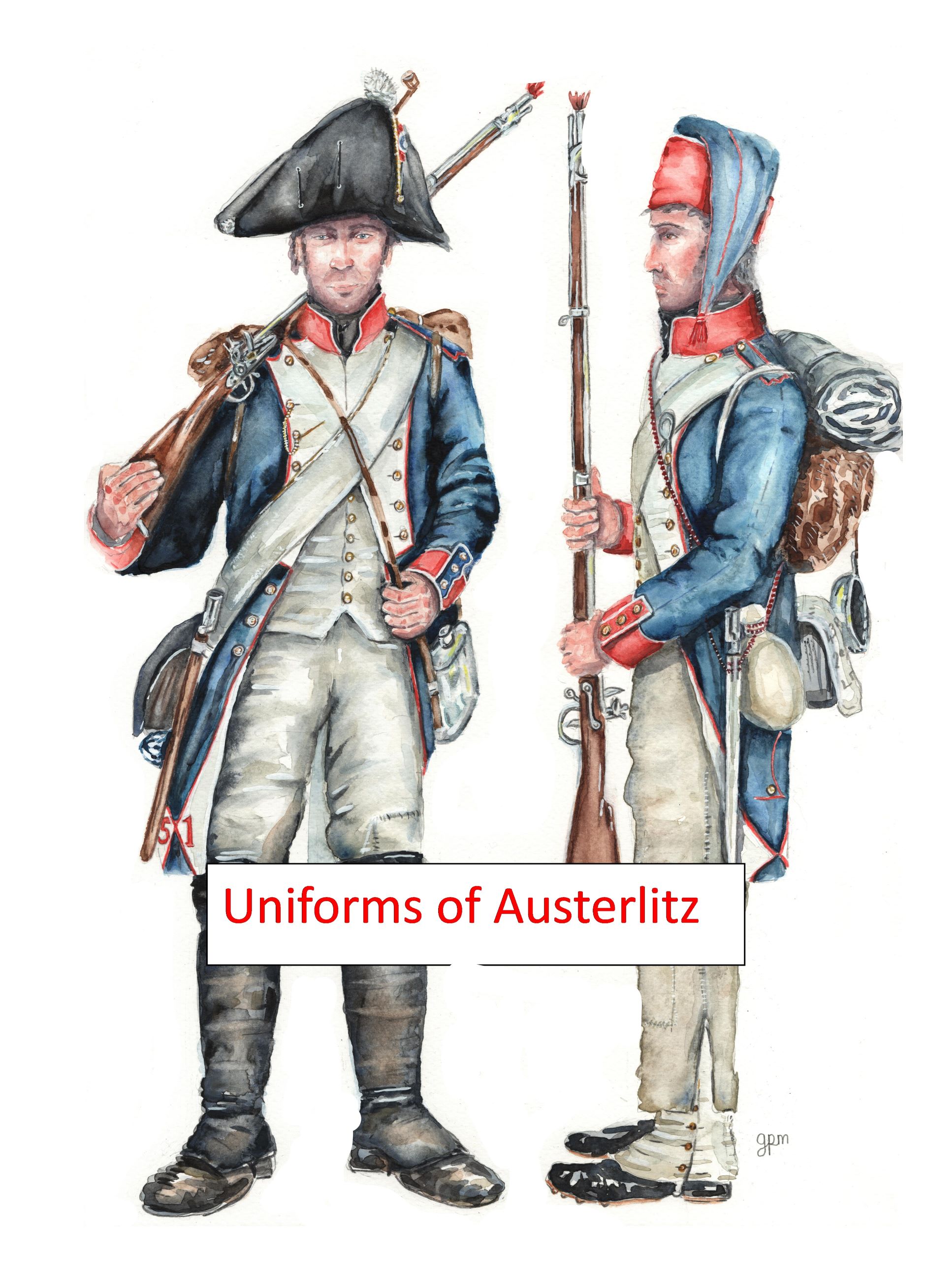

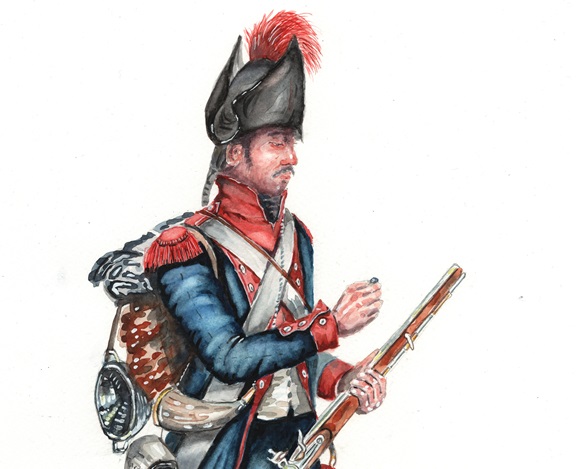
The experience of the average soldier was rarely documented and what was recorded is now often overlooked. By the time Napoleon reached the Pratzen Heights, confirming his great victory at Austerlitz, the worst of the fighting was over. This fighting was recorded by others, like General Thiebault. For the men who experienced and survived this fighting, victory meant something very different. This is part of Thiebault’s account:
Memoires du General Bon Thiebault:
‘entire battalions had been killed without the men leaving the ranks and their bodies lay lined up where their regiments had stood. The stories I heard were horrifying, as up until the very end of the battle we took no prisoners…this sad memory has often come back to me, but I do not think this event necessarily makes me a guilty man. I gave the order on those Heights of Pratzen not to take
any prisoners or to leave anything alive behind us...to save my men.’
The Italian Tirailleur du Po were just one of the many regiments at these battles recruited from the subject peoples of Europe and elsewhere. These were international armies which included entire regiments of Poles, Ukrainians, Romanians, Czechs, Croats, Africans and Hungarians amongst others.
‘The Tirailleurs were advancing from all directions around Sokolnitz and had occupied the hedgerows and houses of the village. They killed many of our men and even wounded my horse, so that we had to retreat back across the bridge. We placed the Vyborg regiment cannons in front of the bridge which held them back for a time.’
Langeron – “Journal inedit’

Uniforms of Jena-Auerstaedt
Uniforms of Jena-Auerstaedt is our new title, out now. As with our second book on Marengo, the book focuses on the allies as well as the French and Prussian regiments at these twin battles – fought on the same day. One major focus is the Army of Saxony, Prussia’s often unwilling ally. We want to engage in dialogue about our books, so please get in touch with us, if you are interested in our current or future publications. We’d like to hear from you. Email us on ddtpreply@yahoo.com.
 DDT Publishing: Uniforms of Austerlitz, Marengo and Jena